 November
12
November
12
Tags
#storyworthy – About that time I had my dream job starting a PMO
…the only way to do great work is to love what you do…
-Steve Jobs
The Challenge
We were the Project Management Office for a new technology division in a matrixed organization. There was no enterprise-wide PMO and very little project management governance, although Finance and Business Operations had project approval processes. We were a team made up of functional resources (business analysts, project managers, and program managers) combined from across the company with varying levels of experience and training in project management. We were responsible for leading cross-functional teams of developers and engineers using both agile and traditional delivery.
Our challenge was to come together to implement a standardized – but lightweight – project management approach that would allow us to be effective and efficient in our organization, give our sponsors and stakeholders the information that they needed in a timely and efficient manner, and deliver quality projects on time and within budget.
The Solution
This was my dream assignment. I worked with my leadership, within the team, and with key stakeholders to plan, design, and implement a Project Management Office for a new technology division.
The Details
Plan. Collect requirements so that you can identify the following:
1.) What type of PMO is required?
2.) What value/ benefit will the PMO bring to the organization?
3.) What does the “to be” state of the PMO look like?
4.) What is the current maturity level of the PMO?
First, start with a stakeholder analysis to determine who could impact or who would be impacted by the PMO. For us, it was: our Senior Leadership Team (VP, Directors), Clients and system users, various development teams (agile and traditional), Finance, and the Engineering teams.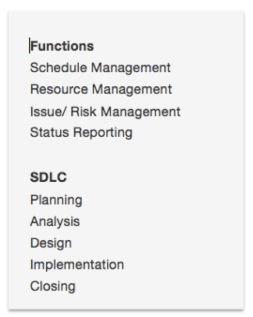
Start with that list to begin documenting the requirements from your stakeholders. I recommend brainstorming with a list of common PMO functions and the SDLC phases.
Some questions you can ask are:
1.) Do they have any existing processes or deliverables in the project management process?
2.) Do they or could they use any project information for reporting or decision-making purposes?
3.) If you were in their role, what project information could be both interesting and useful?
Design. Begin to build a matrix that aligns the functions, benefits, and deliverables from the PMO. Design and repurpose project management templates (e.g., charters, issue/ risk log, project schedules) and tools to support the process. By focusing on the activities that are beneficial for your organization, you will design a process focused on value-added activities and minimize (if not eliminate) ‘busywork.’
Your initial design is only the beginning of the process. Start to shop the idea around. Identify a champion for the process – one of the stakeholders who supports and is a direct beneficiary of the PMO. Validate their requirements and then work to ensure the design meets their needs. Continue to meet with additional stakeholders to review and build out the process until it has been vetted.
Not all of your stakeholders will embrace the PMO for a variety of reasons. My team asked questions to get to the root cause of their objections. We used negotiation and influence to work with the stakeholders to ensure the PMO has the right level of support and was set up to achieve the goals set forth in the requirements and benefits to the organization. This is hard work. We had a series of well-organized meetings, coffee chats, and impromptu phone calls at all levels of the organization to socialize this new idea.
Ultimately, we had buy-in across the key stakeholders. They all had a thorough understanding of the role the PMO would play (the series of meetings generated a de facto Responsibility Matrix chart for phases of the SDLC), the project lifecycle process we were following, and our communication and integration touch points.
Implement. We were given the “Go” to run with the proposed process. As mentioned in the challenge statement, we implemented this in a “process light” culture. Our motto was “We make project management look easy”.
It takes some thought to make a process look easy. We leveraged existing tools to simplify the ramp up time and we held training to strengthen the functional resources’ project management capabilities. We created a combination of simple one-pagers and thorough resources, both for our team of project and program managers to follow and for our partners to understand and reference our project management methodology, processes, and templates. We communicated and communicated more. We made sure our project and program managers had clear expectations in the process. We leveraged metrics and reporting to track adherence to the process.
The Results
Our PMO was a hit! We were able to implement a standardized project lifecycle methodology that was easy to understand, integrated well with our partners, and provided value for the organization. We were able to use this methodology to deliver projects and programs aligned to our organization’s strategy.We tracked and reported key financial, resource, and schedule information in monthly status reports delivered to Leadership, Clients, and the broader organization.
This experience was #storyworthy because I loved the assignment and working with the team so much that I would have done it for FREE! (shhh! don’t tell!) The team of project and program managers that I worked with were entrepreneurial, engaged, and enthusiastic. Our leadership gave us the freedom to implement what was best for the organization. And we did just that – we built a world-class PMO that we all were very proud of and that met the needs of the organization.
To boot, the capstone of this experience was working on the next phase of the PMO office. In the spirit of continual improvement, we were able to document our growth and map out ways to strengthen our capabilities. Click here to see the presentation we shared with our leadership to document our growth and map out ways to strengthen our capabilities.
Do you have any #storyworthy experiences of doing what you love? Please share in the comments below; I would love to hear about them.
 Lead and Deliver